Tommy N. Turner
Independent researcher and writer. Institutional governance, public policy.

Virginia data center series — statewide and analytical volumes
- Transmission Siting Disclosure Capture: TVA, Oncor/LCRA and Dominion Energy Virginia, August 2026
A point-in-time capture of publicly published transmission line siting geographic data, retrieved 15 August 2026 by anonymous query against public ArcGIS REST endpoints.
Point-in-time dataset capturing which utilities publish vs. withhold transmission-siting geographic data (TVA, Oncor/LCRA, Dominion Energy Virginia). - Concentrated Benefit, Dispersed Burden: Who Carries Virginia's Data Center Transmission, and What the Cost-Allocation Record Does Not Trace
Virginia's data centers consume roughly a quarter of the Commonwealth's electricity, and PJM attributes a ten-gigawatt increase in forecast Dominion-zone load by 2029 primarily to them.
Volume I in the Concentrated Benefit, Dispersed Burden series — Virginia transmission cost allocation. Companion Zenodo dataset: 21959988 (utilities transmission-siting geographic data). - The Whole Record: What the Tennessee Valley Authority Publishes When Nothing Requires It
TVA builds transmission lines across seven states and files no siting case for any of them. The GAO reported this to Congress in 1982 and proposed statutory fixes; none were enacted. What TVA chooses to publish is the public record — this volume measures it.
Volume II in the Concentrated Benefit, Dispersed Burden series (Vol I = concept 21895588). 264 pages across fifteen chapters. Codes eighteen TVA project pages and reconstructs the categorical-exclusion record from 11,899 determinations. - What Virginia Is Spending, What Virginia Is Getting: The Commonwealth Data Center Reference
What Virginia Is Spending, What Virginia Is Getting (v5.2) is the comprehensive statewide reference on data center development in Virginia and the anchor volume for a series of county case studies.
v5.3 - Built for Someone Else: Generation, Load, and the Exception in Virginia
Virginia's generation-siting statute reaches two of the four routes now serving data centers, applies its full test to one, and does not reach the other two at all. Built on 108 primary documents, each hashed. Evidence snapshot 24 August 2026.
Companion volume to the Commonwealth Data Center Reference (concept 20679292). Source manifest deposited separately as concept 22099427. SSRN Working Paper Series. - A Line Drawn on a Highway: Virginia's Groundwater Boundary, the Rivers Beyond It, and the Data Center Load the Regime Does Not Reach
Virginia regulates groundwater by asking three categorical questions and never asking how much. Data centers answer all three in the way that exempts them. 89.9% of Virginia's 286 inventoried data-center facilities sit outside every declared groundwater management area, and the boundary is Interstate 95.
Companion volume to the Commonwealth Data Center Reference (concept 20679292); extends the coastal-aquifer thread from Two Systems (21816008) to the full groundwater and surface-water regime. - Where the Instrument Stops: Virginia's Groundwater Ceiling, Its Grandfathered Rivers, and the Load Outside Both
DEQ said it in the SJ 25 study: the strip of Coastal Plain sediment west of Interstate 95 "is disregarded, and I-95 is treated as the approximate western edge of the VCP aquifer system." Virginia drew its regulatory boundary at the same road and regulates as though it were real.
Executive brief synthesizing three deposited water volumes (21556435, 21816008, 22105181). Carries four findings that none of the three volumes makes alone. - Governing the Demand Shock: Local Institutional Variation in Virginia's Data Center Boom (Report)
Virginia hosts the largest concentration of data centers in the world, and between roughly 2018 and 2026 the industry moved out of its Northern Virginia core into more than two dozen counties and independent cities.
REPORT - Governing the Demand Shock: Data Centers, Local Power, and the Distribution of Cost in Virginia
On a Tuesday night in late May 2026, the Hanover County board voted four to three to turn away a 900-megawatt data center, walking away from the largest taxable investment ever offered it, and on water.
BOOK EDITION — sibling to the REPORT - What Tennessee Is Building, and What It Is Not Regulating: A Statewide Data Center Report
Tennessee entered the data center era without deciding to, and built one of the densest hyperscale concentrations in the South with the thinnest governing apparatus this series has documented.
- What Georgia Is Spending, What Georgia Is Getting: A Statewide Data Center Report
Georgia built the second-largest data center market in the United States without ever deciding to.
- Declared, Not Measured: Volumetric Permit Triggers and Sub-Threshold Industrial Water Demand in Georgia
Georgia's 100,000-gallon-per-day groundwater permit trigger runs per person and turns on a quantity that, before a permit issues, exists only as the withdrawer's declaration. A measurement-coincident threshold — the regime regulates what it can already see. Sixteen data-center Development of Regional Impact filings were made between January 6 and July 22, 2026.
Extends the Virginia water thread (references 21816008 and 22105181) into Georgia. Data centers are the occasion; the design property is stated independently as a limiting case of Bennear (2008). - No Field to Land In: How Three States' Water Withdrawal Forms Make Utility-Supplied Data Centers Illegible
A data center that buys treated water from a public utility is, in Virginia and Tennessee by express clause and in Georgia by definition, not a person who withdraws water. Reads the reporting forms each state prescribes, field by field, and asks where on them a delivery to such a facility would be recorded. There is no field built to take it.
Cross-state water-reporting analysis (VA, TN, GA). Documents the record void created by the utility-supplied-exemption plus form-field absence combination. Companion to the Virginia and Georgia water volumes. - Two Systems, One Drought: Virginia's Groundwater Ceiling, Its Rivers, and the Water the Energy Buildout Actually Uses
Virginia's coastal aquifer is capacity-bound; its river system is drought-stressed. The Commonwealth is solving a problem in one by adding to the other, and the data-center buildout is arriving before that trade has been priced.
- The Aquifer Says No: DEQ's SJ 25 Groundwater Study and the Data Center Question East of I-95
In July 2026 the Virginia Department of Environmental Quality published its study of the groundwater supply east of Interstate 95, ordered by the 2024 General Assembly under Senate Joint Resolution No.
- When the Operator Builds the Plant: The Google–CFS Power Purchase Agreement and What It Means for Virginia's Energy Market
Documents the June 30, 2025 Google–CFS power purchase agreement and Eni's September 22, 2025 offtake for the 400-megawatt ARC fusion plant in Chesterfield County — the Fall Line Fusion Power Station. Not a technology profile; examines the commercial instruments themselves and the equity stakes both buyers hold in the developer.
- Where the electricians went: Hyperscale data center construction and building trades membership in federal union filings, 2018 to 2025
Published employment figures for data-center construction come from the industry or from unions testifying on projects. This paper builds an independent series from federal LM-2 filings and IBEW jurisdiction maps: an eight-year panel of inside electrical construction membership for 89 metropolitan locals. Median treated local grew 33.7 percent between 2018 and 2025 against 13.2 percent elsewhere — a 25.8-percentage-point regression difference, randomization p below 0.001.
Working paper v0.1 with complete replication package. Uses federal union filings as an independent labor-measurement source. Effect concentrated in metros with hyperscale campuses; removing top-five-fastest-growing locals leaves 9.0 points and no significance. - Thirteen Cooperatives: Virginia's Distribution Cooperatives and the Arrival of Load Larger Than the System
Thirteen electric distribution cooperatives serve Virginia — the figure most often cited is eleven. Data-center load is arriving on several of them. This reference walks identity and jurisdiction, wholesale supply (nine of thirteen through Old Dominion Electric Cooperative), the seven-case affiliate sequence in which one cooperative was twice refused authority to serve hyperscale load through an unregulated affiliate, and the four large-load rate schedule cases side by side against the investor-owned regime that preceded them.
Reference companion to the Commonwealth Data Center Reference (20679292). Also addresses Va. Code § 56-234 D (2025 Acts of Assembly, chapters 499 and 598), which reframes the affiliate question. References the Mecklenburg (20673484), Botetourt (20673512), Culpeper (20673529), Google–CFS (20679935), and Governing the Demand Shock (20692386) volumes.
Virginia data center series — county case studies
Henrico is the shell every case study clones.
- Case Study: Henrico County — How Two Neighborhoods Forced Virginia's Second-Largest Data Center Jurisdiction to Change Course
Henrico County, Virginia spent two decades recruiting the data center industry and eighteen months learning to govern it.
Henrico — the template - Case Study: Hanover County — Mountain Road, Tract, and the Search for Leverage
On the night of May 27, 2026, after nearly six hours of debate that ran toward midnight, the Hanover County Board of Supervisors voted 4-3 to reject Tract's Mountain Road Technology Park: 430 acres,…
- Case Study: Chesterfield County — The $0.24 Rate, the Thirty-Year Lock, and the Two-Corridor County
Chesterfield built its data-center strategy on a single number: the equipment tax rate set at $0.24/$100 in April 2019 — a deliberate undercut of Henrico's $0.40 and the lowest in Virginia. Google assembled roughly 1,640 acres, Chirisa committed $2 billion, and Commonwealth Fusion Systems selected Battery Brooke for the world's first grid-scale commercial fusion plant. The rate is locked for thirty years.
- Case Study: Mecklenburg County — Boydton, South Hill, and What Fifteen Years of Data Centers Produced
Every other report in this series documents a Virginia county deciding on promises.
- Case Study: The Fredericksburg Ring — Five Jurisdictions, One Corridor, and the I-95 Path South
Since 2022, the five jurisdictions surrounding the Rappahannock River fall line (Spotsylvania, Stafford, Caroline, and King George counties, and the independent City of Fredericksburg) have approved…
- Case Study: Orange County and the Town of Orange — Convergence at Two Scales
In the spring of 2026, two governments whose chambers sit blocks apart in the same small town regulated the same industry in the same season, with different instruments, on different timelines, and…
- Case Study: Louisa County — The First Overlay, the Amazon Retreat, and the $17 Billion Bet
Louisa County, Virginia invented the instrument that the rest of central Virginia is now copying, and then walked away from its central feature before the first imitator finished drafting.
- Case Study: Goochland County — The Overlay, the Lawsuit, and the Template
Every county documented in this series so far decided data centers project by project.
SSRN posted with leading 'a' typo — Revise pending release - Case Study: Botetourt County — Project Raspberry, the Water Authority, and the Wave That Crossed the Blue Ridge
On June 24, 2025, Botetourt County announced that Google had bought 312.55 acres of the county's flagship business park at Greenfield for $14,055,406.37, plus $4 million for county initiatives.
- Case Study: Culpeper County — The Quiet Successor
Culpeper County holds one of the largest accumulations of data center entitlements in Virginia's diffusion ring: roughly 12 to 13 million square feet built or approved across eight campuses, and…
- Case Study: Prince William County — Governance Capture, the Revolving Door, and the Democratic Correction
The largest data-center proposal in American history was filed at the Supreme Court of Virginia three hours before deadline, then withdrawn on July 2, 2026. No court ever reached its merits. Documents how the county got there: the sitting supervisor who signed a contract to sell his own land to one of the developers ten days before joining the application, the board chair with a disclosed six-figure position in the parent company of the other developer, and the primary that reset the board.
- Case Study: Loudoun County, Virginia — The Endgame Case: What It Costs to Change the Rules After the Industry Is Load-Bearing
On March 18, 2025, the Loudoun Board of Supervisors voted 7–2 to require a special exception before a data center could be built in the districts where the use had been permitted by right. The reform never reached the Route 28 corridor, where commercial and industrial zoning is frozen by state statute until 2037. A point-geometry join puts 51 percent of Loudoun's built data-center square footage inside that district — a constraint the county publishes on its own website and that went unmentioned across fourteen months of rewriting the ordinance.
The Endgame Case. Loudoun as the diagnostic county — what it costs to change the rules after the industry is load-bearing. isSupplementTo the Commonwealth Reference (20679292); references every other county case in the series.
Radford and municipal fiscal
- Fiscal Crossroads: An Options Analysis of the City of Radford, Virginia
The City of Radford, Virginia is in formal fiscal distress, designated by the Virginia Auditor of Public Accounts in November 2025 and recommended for state assistance in March 2026, and is in active…
- The Quiet Option: How Radford Drifted Into Fiscal Distress
Radford did not decide to become a fiscally distressed city.
companion to Fiscal Crossroads - Two Cities, One Machine: Radford and Martinsville
Two small Virginia cities ninety miles apart run the same unusual business at almost the same size under the same market pressure.
- What the Foundry Took
What the Foundry Took is a narrative account, drawn entirely from the public record, of how the City of Radford, Virginia reached its 2026 state fiscal-distress designation.
Published as Cardinal News diptych, June 10–11, 2026. SSRN 7247441 was removed. - Virginia College-City Fiscal Comparison: Charlottesville, Harrisonburg, Williamsburg, Radford
This report presents a fiscal peer analysis comparing the City of Radford, Virginia against a defined cohort of three other Virginia independent cities, each anchored by a public four-year…
- Choice Under Constraint: Enterprise-Fund Transfers and Divergent Fiscal Trajectories Among Virginia's Independent Cities
Among structurally similar Virginia independent cities, the evidence is consistent with the proposition that a sustained discretionary interfund transfer, alongside shared structural pressure,…
- The Handle: How American Cities Tax the Universities They Can't Tax
American cities generally cannot tax the property of colleges and universities their states have exempted.
AI governance in higher education
- Governance Without Readiness: How 53 American Universities Responded to Generative AI
Abstract American universities responded to generative AI primarily by governing it.
Same work as SSRN 'The Control Trap' — do not treat as two - Virginia Tech: Comprehensive AI Governance & Activity Inventory
A 170-page public-source inventory of artificial intelligence governance, teaching, research, and operations at Virginia Tech.
- Lehigh University: Comprehensive AI Governance & Activity Inventory
A 188-page public-source inventory of artificial intelligence governance, teaching, research, and operations at Lehigh University.
- University of Virginia: Comprehensive AI Governance & Activity Inventory
A 362-page public-source inventory of artificial intelligence governance, teaching, research, and operations at the University of Virginia.
- Marymount University: Comprehensive AI Governance & Activity Inventory
Abstract This document inventories what Marymount University has said and done publicly about artificial intelligence as of April 6, 2026.
- William & Mary: Comprehensive AI Governance & Activity Inventory
William & Mary has built much of a formal AI governance apparatus in under three years: a provost-authorized policy initiative, a published set of GenAI guidelines, enterprise tool deployments, a new…
- AI Governance Peer Institutional Benchmark: William and Mary's 23 BOV-Adopted National Peer Institutions
A 121-page public-source benchmark of generative AI governance and teaching posture across the 23 institutions adopted by William & Mary's Board of Visitors as its national peer group.
- AI in Virginia Higher Education: Public-Source Reference Guide for 30 Four-Year Institutions
A 311-page public-source reference guide compiling publicly available information on how Virginia's four-year colleges and universities are addressing generative artificial intelligence in…
James City County governance
- The Working Majority Public Dissent and Decision-Making on the James City County Board of Supervisors, 2010–2026
Abstract This paper documents how a working majority on the James City County Board of Supervisors has handled organized public opposition across a sixteen-year period.
- Two Changes on the James City County Board of Supervisors: A Longitudinal Cohort Analysis, 2010–2026
The James City County Board of Supervisors changed how it makes decisions twice between 2010 and 2026, on different timelines that require separate explanations.
- Representative Judgment After Public Opposition
This teaching case examines representative judgment, institutional continuity, changing positions in elected office, and procedural legitimacy during the James City County, Virginia Government Center…
McGlennon. SSRN 7248281 was removed. - Public Participation and Representative Judgment in James City County
This teaching case examines representative judgment, public participation, financing structures, and procedural legitimacy during the James City County, Virginia Government Center controversy between 2023 and 2025.
Null. SSRN 7248319 was removed.
Datasets and reference materials
Companion datasets, corpora, and reference documents. Cite the parent report where applicable.
- Fiscal Crossroads Workbook: City of Radford Audited Fiscal Data and Reconciliations, FY2011-FY2024
The reproducibility workbook behind the Radford fiscal-distress research.
Replication workbook for Fiscal Crossroads - Governance without readiness: coding dataset of 53 US universities' generative-AI governance and readiness
Institution-level coding of 53 US universities on four governance indicators and five readiness indicators, plus a descriptive AI-detection posture and a five-category whole-profile classification.
Coding dataset for Governance Without Readiness - Virginia Data Center Research & Industry Directory
Version 3.0 incorporates three months of portfolio work since v2.1 (March 22, 2026) and a full June 2026 re-verification of every entry.
Contact directory across Virginia data-center research - Regional Government Records Corpus: A Longitudinal Public-Meeting Archive for Local Governance Research in Virginia
The Regional Government Records Corpus is an independently assembled longitudinal archive of local-government public meeting materials spanning eleven Virginia jurisdictions across the Hampton Roads,…
Statewide public-meeting archive — approximately 87,800 files across eleven Virginia localities (five at research depth, two comparison cases, four capability probes). Proof of concept for a statewide Virginia local-government records archive. - Regional Government Records Corpus: Institutional Documentation Package (Volumes I-III)
A three-volume institutional documentation package for the Regional Government Records Corpus, an independently assembled longitudinal archive of Virginia local-government public meeting records…
Three-volume institutional documentation package for the Regional Government Records Corpus (Overview, Methodology, Partnership Pitch). - Source manifest and datasets for 'Built for Someone Else: Generation, Load, and the Exception in Virginia'
The data apparatus for Built for Someone Else: Generation, Load, and the Exception in Virginia (Virginia Data Center Series — Analytical Volumes, Version 1.0), concept DOI 10.5281/zenodo.22096613.
Source manifest for Built for Someone Else (concept 22096613) — 125 files including 108 primary source documents, each SHA256-hashed with URL of origin.
Essays
- The Flinch That Never Came
Some institutional damage does not look like panic. It looks like composure.
- 98 Percent Built AI Committees. 5.7 Percent Included Career Services
What 53 American universities built in response to generative AI.
- The Quiet Disappearance of a Shared Baseline
A shared baseline is infrastructure, not content.
- Promoted Past Learning: What AI Is Quietly Doing to the People Who Use It
Reviewing a document at work. Increasingly, the process behind the output is harder to see.
- Synthetic Participation Is Breaking Professional Trust
When engagement scales faster than accountability, trust becomes expensive.
- Law Over Ego: Martin Luther King Jr. Day, and the test we keep failing
Every generation inherits the same choice.
- If AI Is Everywhere, Why Isn't Productivity?
AI now dominates earnings calls, capital spending plans, and boardroom strategy. And yet the surge isn't there. Not yet.
- AI Didn't Fire Anyone. Leadership Did.
AI is being cited far more often than it is actually responsible.
Op-eds and guest columns
- The thousand-dollar line
Loudoun priced the fix at $1,000 in 2016 and passed on it, citing competitive disadvantage. A decade later, Prince William raised its residents' 18 recommended sound values by 6 decibels each — and that weakened standard is now the strictest thing Virginia has.
Virginia Mercury ·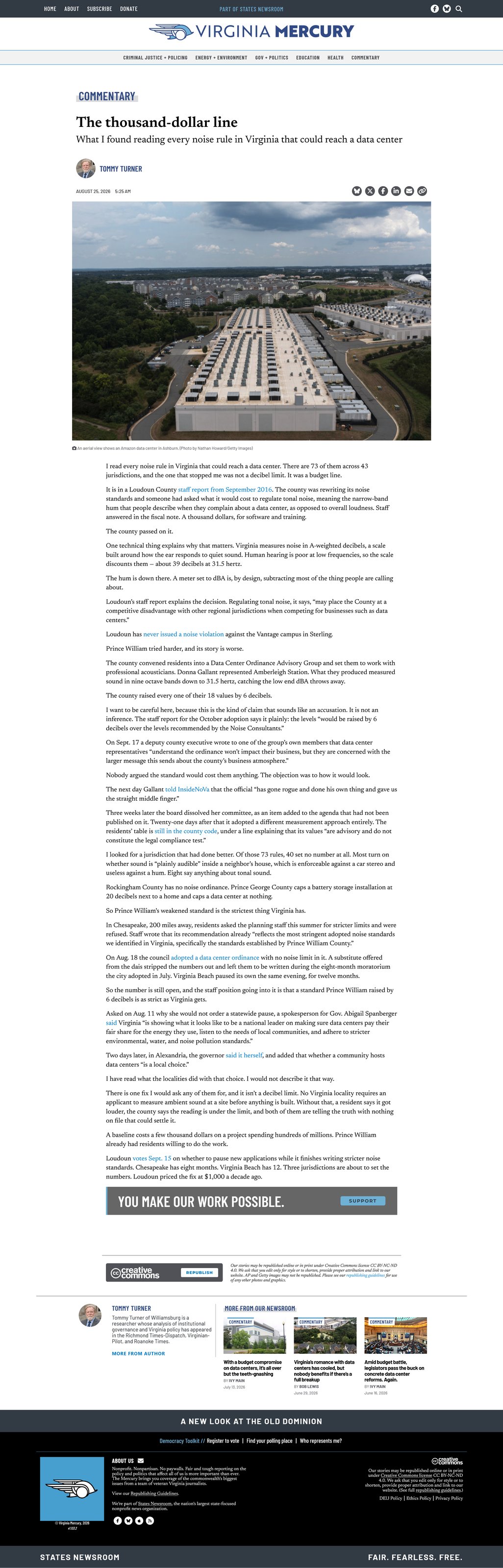 1 pageDeck: What I found reading every noise rule in Virginia that could reach a data center. 73 rules across 43 jurisdictions.
 - Researcher: Buckingham will host more of this power line than any county in Virginia, and it has the least say about it
Buckingham hosts more of the Valley Link line than any other Virginia county — more than Louisa, Orange, or Culpeper, all of which have data centers. Tested against 2,000 random corridors, the route runs through data-center counties more often than chance would allow. Nobody aimed it there, and nobody in Virginia can undo it.
Cardinal News ·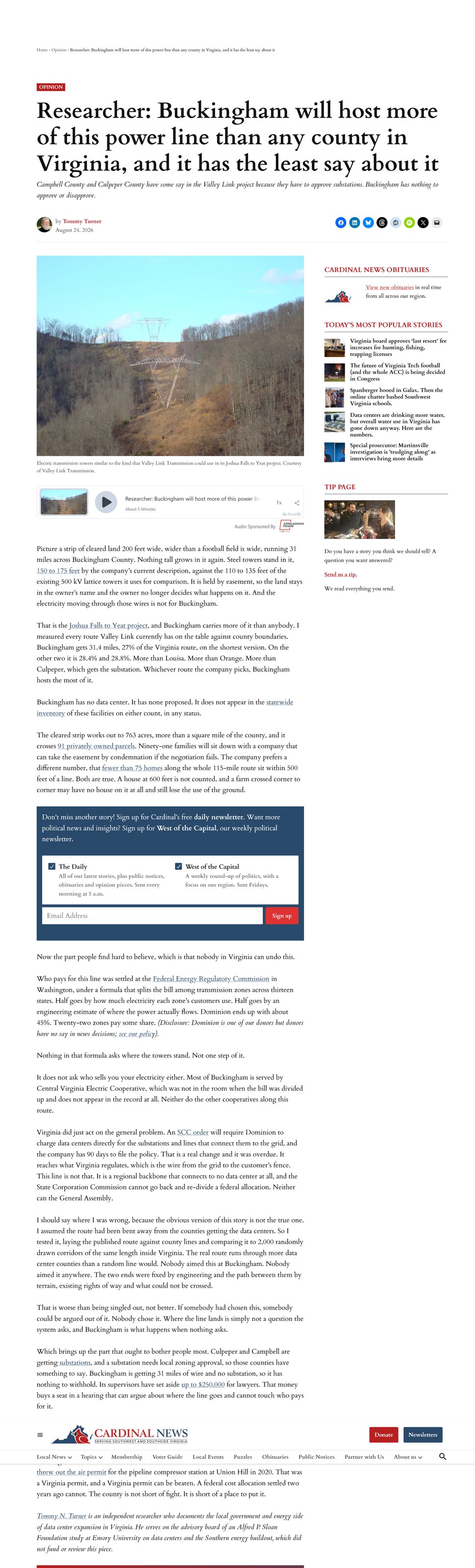 1 pageCompanion to the PJM Schedule 12 piece (RTO Insider, Aug 12) and Zenodo 21895588 (Concentrated Benefit, Dispersed Burden).
 - Local governments cut out the public
Botetourt, Wythe, and Pulaski each disclosed on schedule. The problem is the schedule — information arrives after a project has accumulated enough commitments to make reversal expensive.
The Roanoke Times ·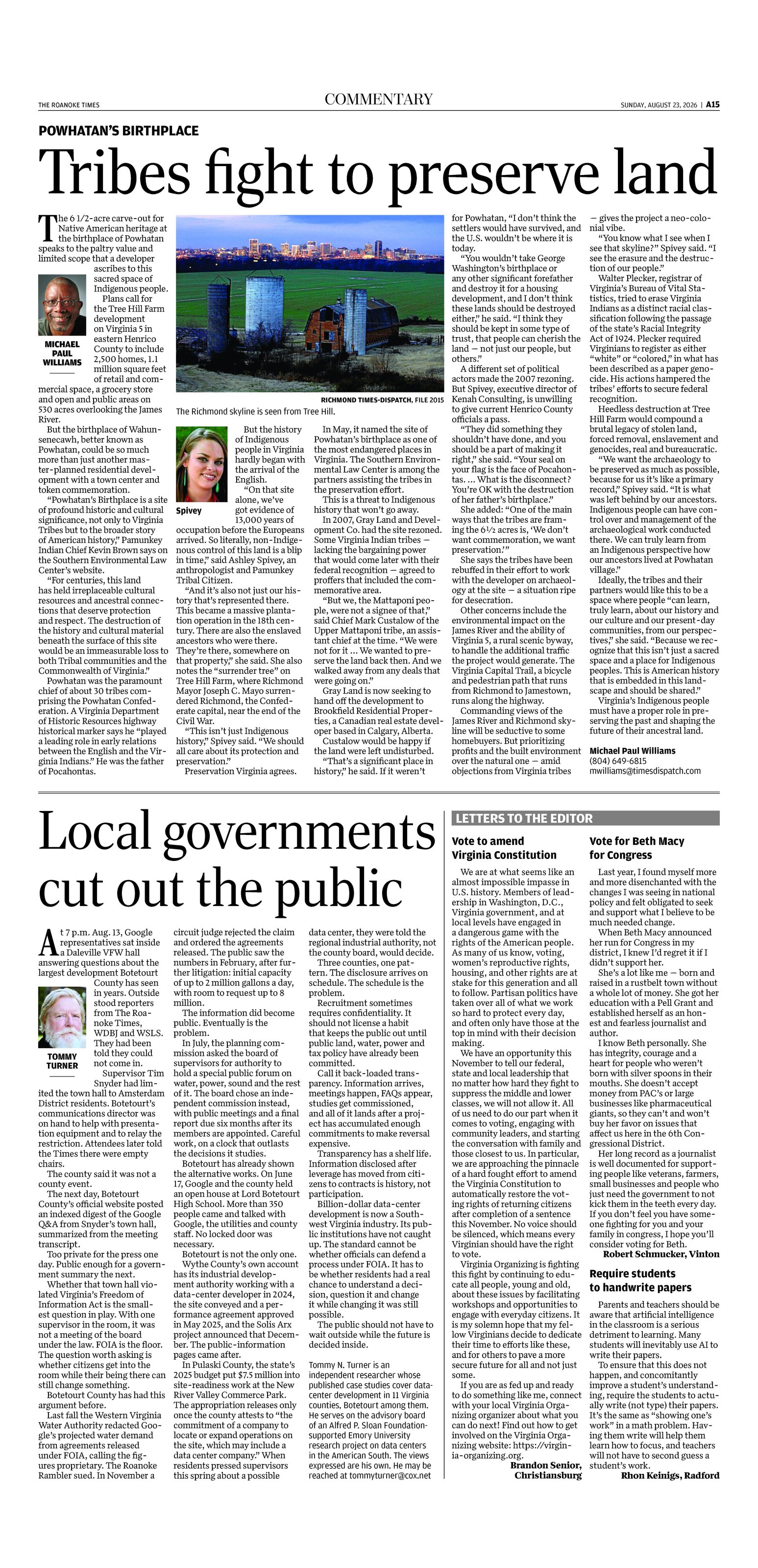
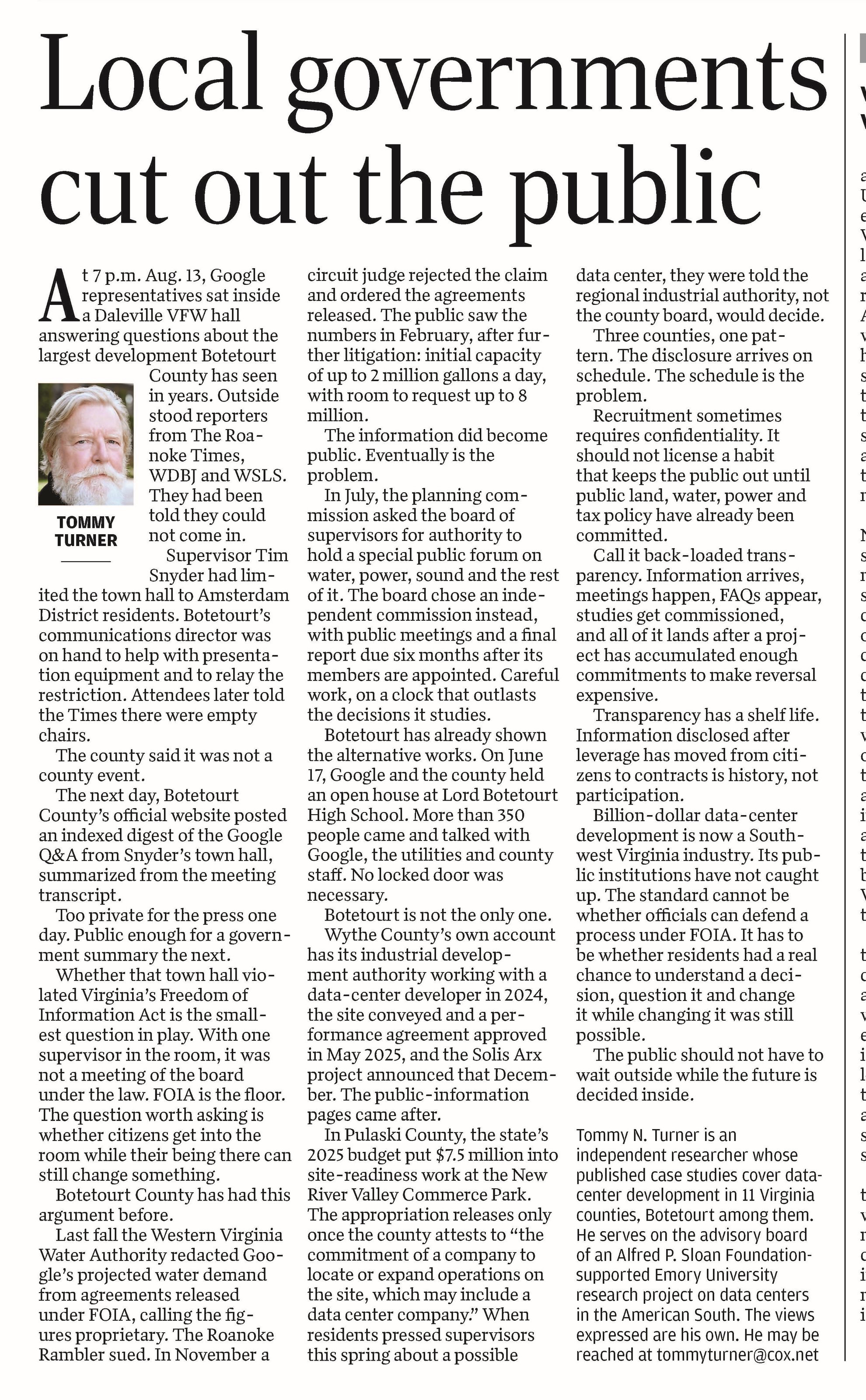 2 pagesPrint, Sunday A15, August 23, 2026. Web headline: "Commentary: The public interest shouldn't be an afterthought."
 - Half of a 765-kV Line in PJM is a Postage Stamp; the Other Half Stops at the Zone Line
PJM's Schedule 12 allocates half the cost of a data-center-driven transmission line by geography and half by ignoring it — nothing in the tariff conditions on where the burden actually falls.
RTO Insider · 1 pageStakeholder Forum. Companion to Zenodo 10.5281/zenodo.21895588 (Concentrated Benefit, Dispersed Burden). Link is subscriber-only.
 - Column: Virginia undecided on who gets water from refilled aquifer
If the Potomac aquifer is refilled through SWIFT injections, Virginia has not decided who gets the water first. That policy vacuum is the piece.
The Virginian-Pilot / Daily Press ·
 2 pagesPrint: shared editorial page, Wednesday August 12, 2026. Also at pilotonline.com under the same headline.
 - Column: Virginia groundwater limits put growth in question
DEQ's SJ 25 study finds Virginia's Coastal Plain aquifer capacity is the ceiling; existing pumping and JCSA's permit renewal now sit under it.
Richmond Times-Dispatch · 1 page
 - Williamsburg Watch column on JCSA permit renewal implications
What the DEQ technical evaluation implies for the JCSA groundwater permit renewal — and for James City County's growth assumptions underneath it.
Links to Williamsburg Watch opinion index; individual permalink pending - Williamsburg Watch column on Virginia SJ 25 DEQ groundwater study
Introducing the DEQ SJ 25 groundwater study, released six months past its statutory deadline: the Coastal Plain aquifer system has limited capacity for new withdrawals east of I-95.
Links to Williamsburg Watch opinion index; individual permalink pending - Trump's Hormuz toll reversed, but the damage remainsRichmond Times-Dispatch ·
 1 page
 - Radford named its distress. It hasn't named the cure.
- Researcher: The bill came dueRadford diptych, part 2 of 2
- Researcher: What the foundry took from RadfordRadford diptych, part 1 of 2 — also deposited as Zenodo 20612127
- When commemoration becomes political powerRichmond Times-Dispatch ·
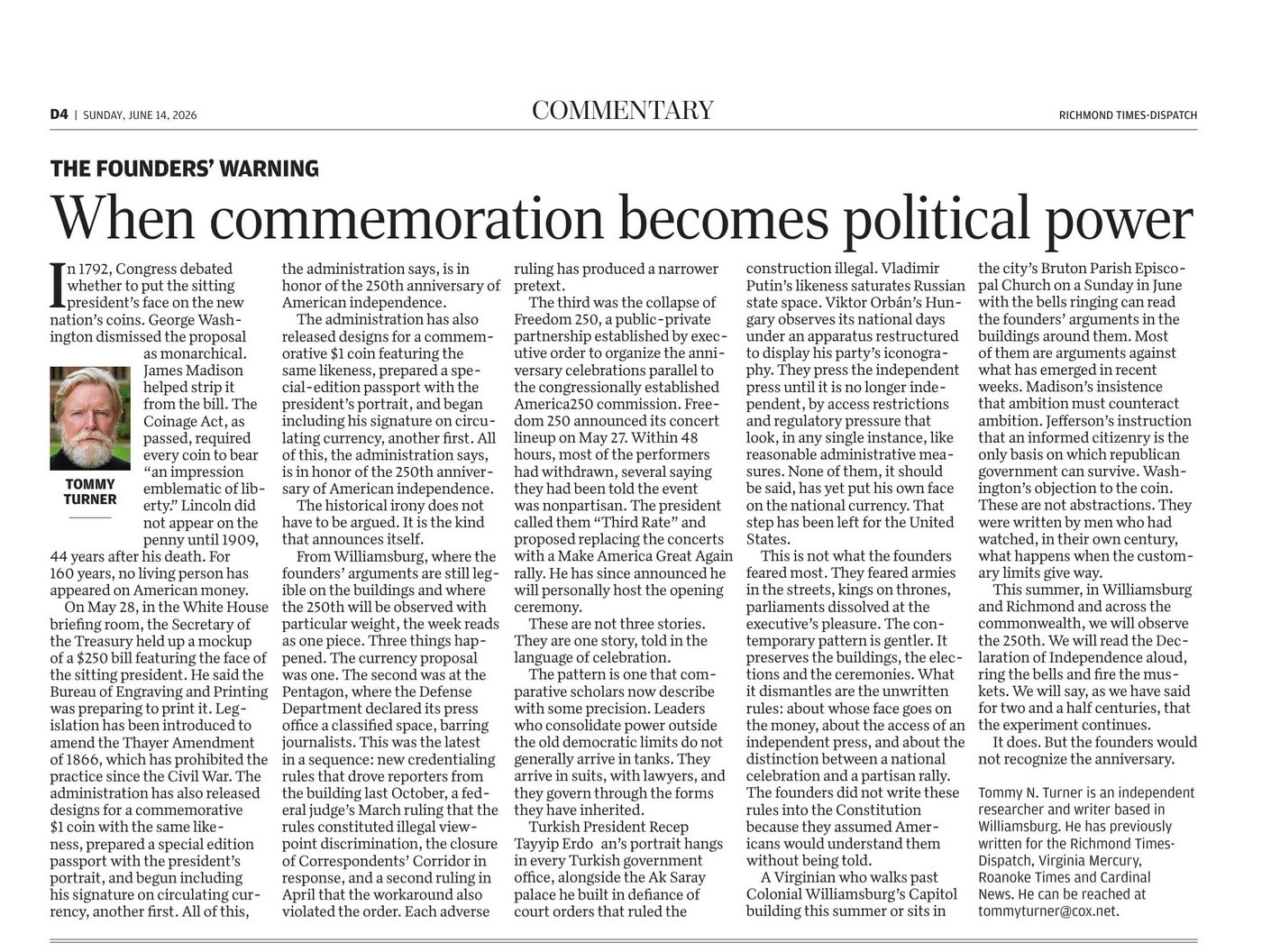 1 pagePrint, Sunday D4 — kicker: The Founders' Warning. URL pending.
 - The anniversary America's founders wouldn't believeRichmond Times-Dispatch ·


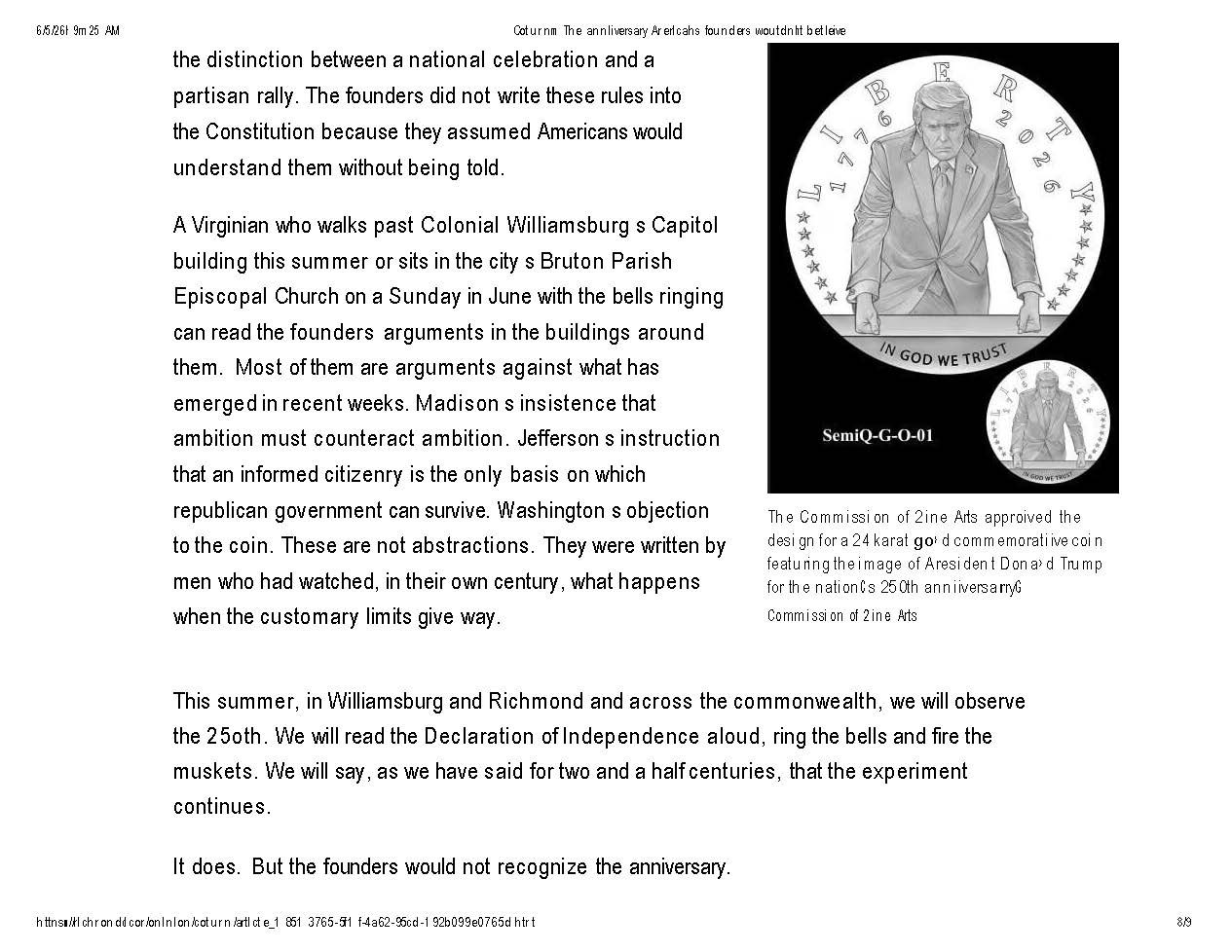
 7 pages
 - Early warning signs of Radford's fiscal distress
- The case against Secretary Hegseth asking for $1.5 trillionThe Virginian-Pilot ·

 2 pages
 - China talks cannot replace a congressional vote on warRichmond Times-Dispatch ·
 4 pages
 - As James City County budget adoption looms, disconnect between supervisors and residents is glaringly apparent
- Column: Who is counting taxes in James City County
- Researcher: Spanberger visited Southwest Virginia. The way she visited tells the region what she thinks of it.
- Spanberger's data center position is the test of her affordability message
- More thoughts about budgeting, taxes — a letter to the James City supervisors
- Letter to JCC Supervisors
- Commentary: Taxing past the breaking point
James City County residents count taxes cumulatively; the board counts them categorically. That mismatch is the piece.
The Virginia Gazette · 1 page
 - Pentagon press crackdown ruled unconstitutional — twice
- Spanberger's first 100 days are flashing a warning Virginia Democrats should not ignoreVirginia Mercury ·
 3 pages
 - Why Virginia's data center deal no longer adds up
The Senate's move to end the $1.6 billion sales-tax exemption is overdue honesty, not anti-growth policy. Virginia is subsidizing a dominant industry to stay somewhere it was going anyway.
Richmond Times-Dispatch / Daily Progress ·
 2 pagesAlso ran in The Daily Progress under the headline "The data center numbers don't add up" (March 24, 2026).
 - A quiet digital fence around the Historic TriangleThe Virginia Gazette / Daily Press ·
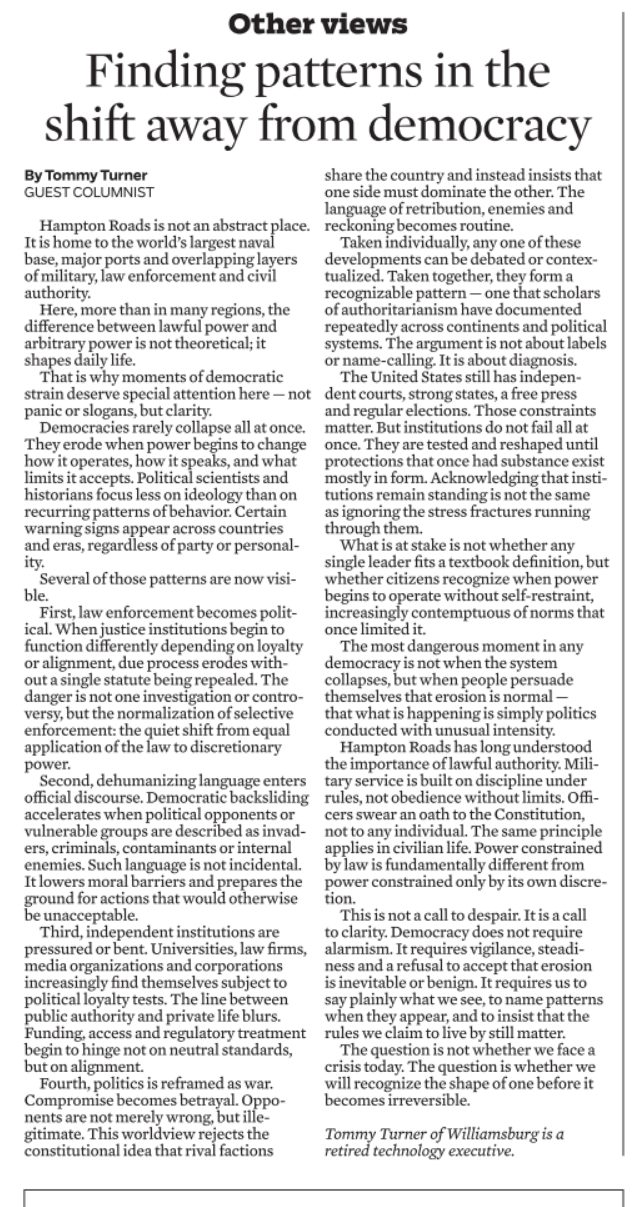
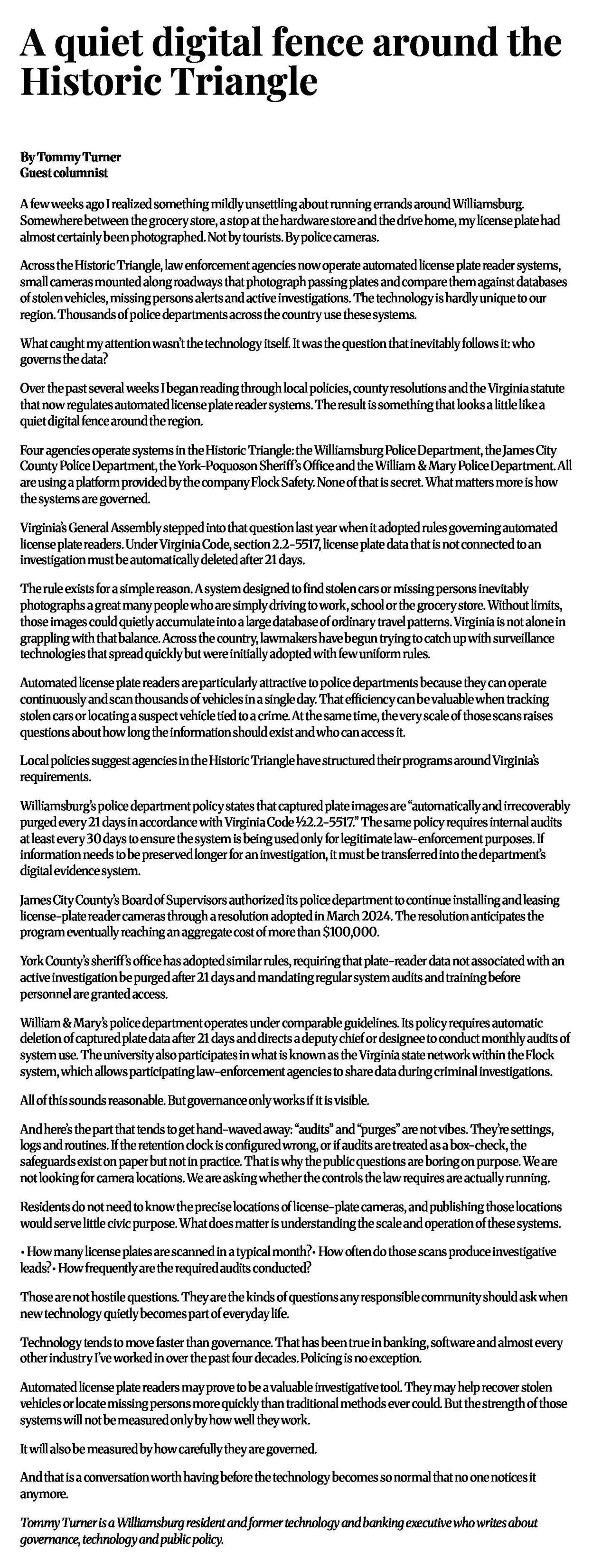 2 pages
 - Column: Finding patterns in the shift away from democracyThe Virginian-Pilot / Daily Press ·
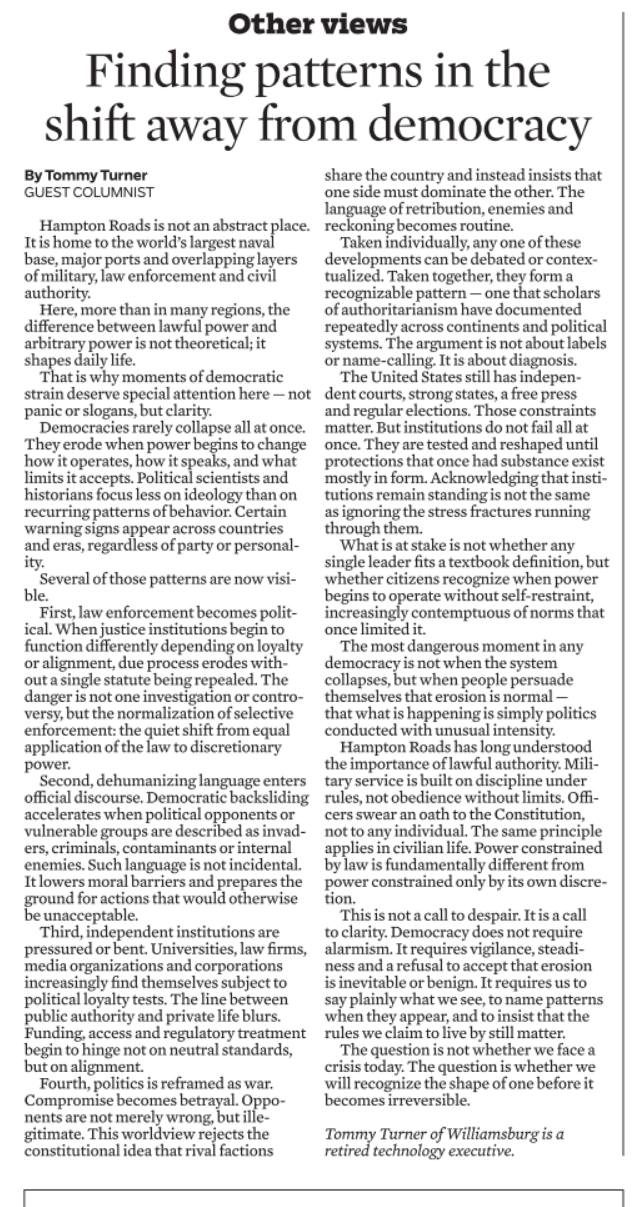 1 page
 - Virginia should stop subsidizing data centersThe Roanoke Times ·
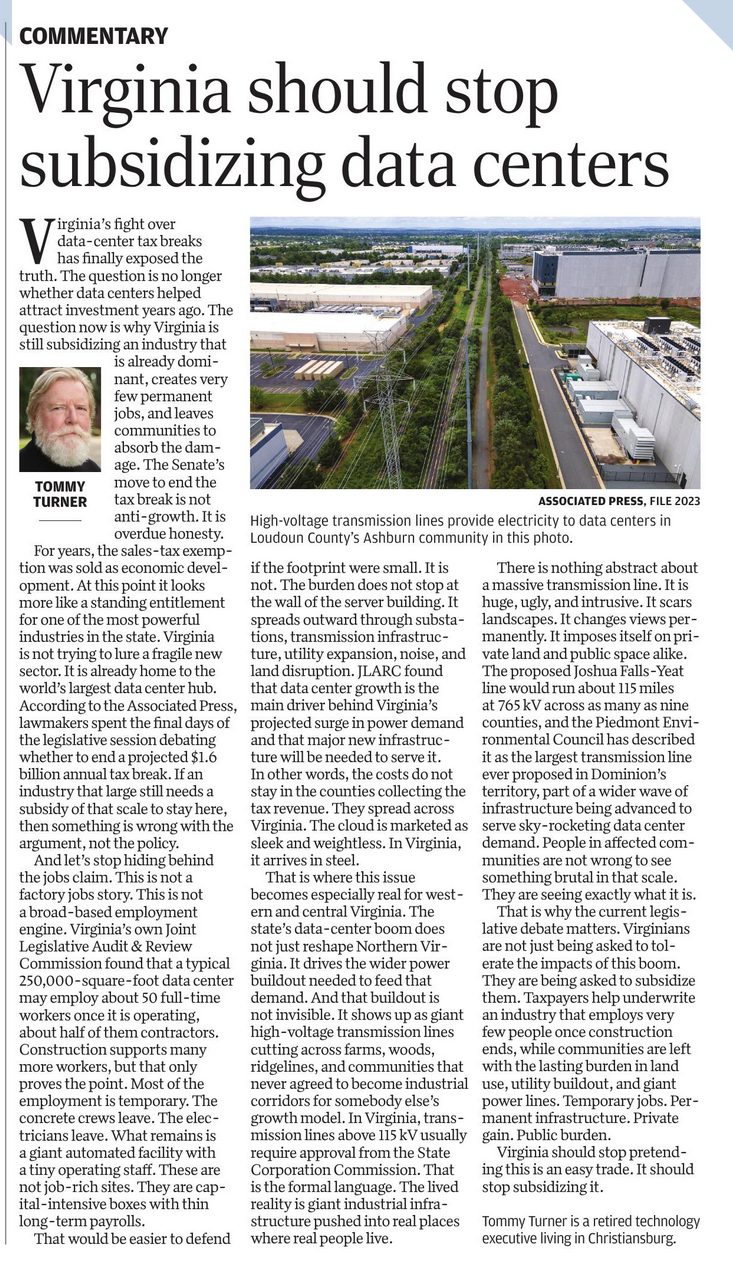 1 page
 - What Customs taught America about power
Longform
- Mounts Bay: A James City County Story, 2012–2026
A book-length narrative of the James City County Board of Supervisors, told through the chamber on Mounts Bay Road, 2012 through 2026. The room is the constant; the plot is what the room actually holds.
v3, revision 4. Regional Government Records Corpus series. - Three Rooms: Williamsburg and James City County and the Joint School System, 1955–2026
A seventy-year institutional history of the joint school system serving Williamsburg and James City County, ending in the July 2023 termination vote and the October 2025 three-board signing that formalized the separation.
v3, revision 6. Regional Government Records Corpus series. - If the Regime FitsParent essay to the June 5 RTD column
Cited in
- The Hidden Net Cost of Data Center Construction and Operation for Household Service Pricing
Peer-reviewed research article by Shafaghat, Klimenko, Hu, Keyvanfar and colleagues on data-center cost allocation to household service pricing. Cites the Commonwealth Data Center Reference (SSRN 6941078) in the operational cost category alongside 11 other sources.
- New Virginia transmission line could clear 763 acres in county left with the burden, not the power
Third-party reporting on the Valley Link / Buckingham analysis: cites the 2,000-random-corridor test by name, plus the 31.4-mile Buckingham finding and the no-substation leverage argument.