Tommy N. Turner
Independent researcher and writer. Institutional governance, public policy.

Local Government in Virginia
Research on how Virginia counties, cities and towns decide: data center rezonings and tax rates, James City County's board of supervisors since 2010, and city budgets under strain, built from public records such as minutes, packets, budgets, audits and agreements. Every report is deposited on Zenodo with a DOI and free to read. 33 works and 15 columns. Suggested starting points are marked with a star. For data center work by county or city, see data centers by Virginia locality.
Data centers and county decisions
How Virginia counties and towns decided on data centers, read from their own packets, minutes, ordinances and agreements.
- Governing the Demand Shock: Local Institutional Variation in Virginia's Data Center Boom (Report)
This report compares how thirteen Virginia localities handled the spread of data centers from 2018 to 2026. Its central finding: the deciding factor was timing, when a community reformed its rules relative to the industry's arrival, not geography or project size.
The compact report. The book edition carries the full narrative. - Governing the Demand Shock: Data Centers, Local Power, and the Distribution of Cost in Virginia
This book compares how Virginia's localities governed the data center wave from roughly 2018 to 2026, drawing on thirteen local case studies. Its finding: what separated communities that captured the benefits while containing the costs was neither geography nor project size, but the timing of local reform relative to the industry's arrival.
Book edition of the report, written for a general reader. - Below the Curve: What Virginia Counties Chose Not to Measure
In 2016, Loudoun County staff recommended against regulating tonal noise, the steady hum residents near data centers describe. They priced the alternative at $1,000 and wrote that it could put the county at a competitive disadvantage. The county declined.
Supplement to the Commonwealth Data Center Reference (20679292). The county noise ordinance census workbook and a source companion are deposited in the same record. References the Loudoun (22374193), Prince William (20673498) and Pittsylvania (22968398) case studies and Governing the Demand Shock (20692386). - Case Study: Loudoun County, Virginia — The Endgame Case: What It Costs to Change the Rules After the Industry Is Load-Bearing
On March 18, 2025, Loudoun's supervisors voted 7-2 to require board approval for data centers where they had been allowed by right, meaning without a public hearing.
The Endgame Case. Loudoun as the diagnostic county — what it costs to change the rules after the industry is load-bearing. isSupplementTo the Commonwealth Reference (20679292); references every other county case in the series. - Case Study: Prince William County — Governance Capture, the Revolving Door, and the Democratic Correction
On March 31, 2026, Virginia's Court of Appeals upheld a ruling that voided the Prince William Digital Gateway, three data center rezonings covering about 1,760 acres. The hearing had not been properly advertised.
- Case Study: Henrico County — How Two Neighborhoods Forced Virginia's Second-Largest Data Center Jurisdiction to Change Course
On June 10, 2025, Henrico County's Board of Supervisors voted 5-0 to end by-right approval of data centers, meaning staff approval without a public hearing. New stand-alone data centers now need public hearings and the board's approval.
The first case study in the county series. - Case Study: Hanover County — Mountain Road, Tract, and the Search for Leverage
On May 27, 2026, Hanover County's supervisors turned down a 900-megawatt data center campus, Tract's Mountain Road Technology Park, by a 4-3 vote.
- Case Study: Chesterfield County — The $0.24 Rate, the Thirty-Year Lock, and the Two-Corridor County
In April 2019, Chesterfield County's Board of Supervisors set its tax on data center equipment at $0.24 per $100 of value. It was called the lowest rate in Virginia, and it deliberately undercut Henrico.
- Case Study: Pittsylvania County — The County Turned Down One Data Center Plan, Then Rezoned for a Bigger One
On April 15, 2025, Pittsylvania County's Board of Supervisors voted 6-1 to deny a rezoning of 763 acres for a private gas power plant and data centers. It had first refused the applicant's request to withdraw.
Refusal, then entitlement by ordinance on the county's own motion. Traces the Berry Hill loop and substation built by Appalachian Power under the business-park pilot statute. isPartOf the Commonwealth Reference (20679292). Evidence snapshot 25 September 2026. - Case Study: Mecklenburg County — Boydton, South Hill, and What Fifteen Years of Data Centers Actually Bought
On August 27, 2010, Microsoft's plan for a data center in Boydton, the Mecklenburg County seat, was announced: up to $499 million in investment and 50 jobs. The buildout has since reached the edge of South Hill.
- Case Study: Botetourt County — Project Raspberry, the Water Authority, and the Wave That Crossed the Blue Ridge
On June 24, 2025, Botetourt County announced that Google had bought 312.55 acres of the county's Greenfield business park.
- Case Study: Culpeper County — The Quiet Successor
On September 2, 2025, Culpeper County's supervisors unanimously required a special permit for data centers on industrial land countywide, exempting the technology zone and its five approved projects.
- Case Study: Louisa County — The First Overlay, the Amazon Retreat, and the $17 Billion Bet
On April 3, 2023, Louisa County's supervisors adopted Virginia's first Technology Overlay District, allowing data centers without a public hearing across roughly 6,400 acres. Within five months, Amazon Web Services committed $11 billion to two campuses there.
- Case Study: Goochland County — The Overlay, the Lawsuit, and the Template
At a November 6, 2025 meeting that ran past midnight, Goochland County's supervisors voted 4-1 to adopt a data center overlay of roughly 4,400 acres along Route 288, most of it with no public hearing per project. More than 80 people spoke against it.
- Case Study: Orange County and the Town of Orange — Convergence at Two Scales: One Industry, Two Governments, and the Entitlement Neither Can Reach
On February 17, 2026, the Town of Orange's council ended by-right data centers, those allowed without a public hearing, in its town center and required a special permit in every district where they are still allowed. On April 28, 2026, Orange County's supervisors voted 5-0 to confine county data centers to a Technology District that, as of June 12, 2026, covered no land.
- Case Study: The Fredericksburg Ring — Five Jurisdictions, One Corridor, and the I-95 Path South
Between 2022 and June 12, 2026, Spotsylvania, Stafford, Caroline and King George counties approved data center campuses with at least 5.4 gigawatts of reported capacity.
- Case Study: Fauquier County and the Town of Warrenton: The Restrictions Came After the Entitlements, and the Town Changed Sides
In February 2023, the Warrenton Town Council approved an Amazon data center, 4-3. The town approved its site plan in April 2024. It remains unbuilt.
Two governments in one county: the Town of Warrenton's Amazon permit, now struck as a use and challenged in court, and Fauquier County's restrictions at Remington and Vint Hill, adopted after the entitlements. Corrects the series' earlier use of Fauquier as a refusal case. Record read through 1 November 2026.
James City County
The board of supervisors' record since 2010, and two book-length histories, one of them on the joint school system with Williamsburg.
- The Working Majority Public Dissent and Decision-Making on the James City County Board of Supervisors, 2010–2026
This working paper examines how James City County's Board of Supervisors handled organized public opposition from January 2010 through February 2026. Under its strict test, four votes qualify: the Hazelwood Farms rezoning in February 2022 and three Government Center votes in 2025. The board approved all four.
- Two Changes on the James City County Board of Supervisors: A Longitudinal Cohort Analysis, 2010–2026
This working paper studies how James City County's Board of Supervisors made decisions from 2010 to early 2026, using 3,136 recorded votes. It finds two changes, at different times, needing separate explanations.
- Representative Judgment After Public Opposition
On October 14, 2025, three weeks before an election, James City County's Board of Supervisors voted to approve a $16.5 million early site work package for its Consolidated Government Center. Residents had cited a petition approaching 1,000 signatures and asked the board to wait.
- Public Participation and Representative Judgment in James City County
On October 14, 2025, three weeks before a county election, James City County's Board of Supervisors approved two steps for its Consolidated Government Center: vacating part of a road right-of-way and a $16.5 million early site work package.
- Mounts Bay: A James City County Story, 2012–2026
This book follows James City County's Board of Supervisors through its public meetings on Mounts Bay Road, from October 2012 to February 2026. Its central finding: a board that took its staff and Planning Commission recommendations as binding in 2012 came to override them on a recognizable set of cases, over split votes in 2016 and 2017 and by consensus from 2018 through 2023.
Book-length narrative, v3 rev 4. isPartOf the Regional Government Records Corpus (22045517/20088873). - Three Rooms: Williamsburg and James City County and the Joint School System, 1955–2026
On October 10, 2025, James City County's supervisors, the Williamsburg City Council and the joint school board voted unanimously for a new contract for the school system the city and county have shared since 1955. For the first time, the school board is a party.
Book-length institutional history, v3 rev 6. isPartOf the Regional Government Records Corpus (22045517/20088873).
City finances
Radford's fiscal distress, Virginia's independent cities, and how cities raise revenue from universities they cannot tax.
- Fiscal Crossroads: An Options Analysis of the City of Radford, Virginia
This options analysis of Radford's finances calls one fact the most important: the general fund does not cover its own operations. In fiscal 2024 it took in $25.43 million and spent $33.14 million; even with money moved in from the electric utility, it ran about $3.74 million short.
- The Quiet Option: How Radford Drifted Into Fiscal Distress
This study traces how Radford became a fiscally distressed city, using audited financial statements from 2011 through 2024. It finds that in every audited year, the city moved money from its electric utility into its general fund, $52.04 million over those years.
Companion to Fiscal Crossroads. - Two Cities, One Machine: Radford and Martinsville
This report compares Radford and Martinsville, small Virginia cities that each own an electric utility and resell wholesale power to residents. In the year that ended June 30, 2024, each utility spent 80.8 cents of every revenue dollar on purchased power.
- What the Foundry Took
In April 2017, Radford's city council passed a budget 3-2 over a warning, read into the minutes, that it was not sustainable and drew too heavily on the city's reserves.
Published as Cardinal News diptych, June 10–11, 2026. - Virginia College-City Fiscal Comparison: Charlottesville, Harrisonburg, Williamsburg, Radford
This report compares the finances of four Virginia independent cities that host public universities: Charlottesville, Harrisonburg, Williamsburg and Radford. It finds that over the years studied, Radford is the only one whose net position, roughly what a government owns minus what it owes, declined, falling 35 percent while the other three grew.
- Choice Under Constraint: Enterprise-Fund Transfers and Divergent Fiscal Trajectories Among Virginia's Independent Cities
This working paper compares Radford with similar Virginia cities. It finds the evidence consistent with this: a yearly transfer from Radford's electric utility to its general fund, alongside real structural pressure, materially reduced the city's margin of safety.
- The Handle: How American Cities Tax the Universities They Can't Tax
This book examines how cities raise money connected to universities exempt from property tax. Its central argument: state law, much of it old and written for other purposes, often decides what a city can collect more than negotiations do.
Records and data
The public-meeting archive and the data behind the reports.
- Regional Government Records Corpus: A Longitudinal Public-Meeting Archive for Local Governance Research in Virginia
The Regional Government Records Corpus is an independently assembled longitudinal archive of local-government public meeting materials spanning eleven Virginia jurisdictions across the Hampton Roads,…
Statewide public-meeting archive — approximately 87,800 files across eleven Virginia localities (five at research depth, two comparison cases, four capability probes). Proof of concept for a statewide Virginia local-government records archive. - Fiscal Crossroads Workbook: City of Radford Audited Fiscal Data and Reconciliations, FY2011-FY2024
The reproducibility workbook behind the Radford fiscal-distress research.
Replication workbook for Fiscal Crossroads - Replication materials: by-right zoning, early vesting and the reach of local reform in Henrico County, Virginia, 2009 to 2026
Version 1.2, October 11, 2026.
Replication materials (v1.1) for a single-case documentary study of Henrico County's June 10, 2025 ordinance ending by-right approval of data centers — what the reform reached and who got a hearing. Supplement, tables, figure data and working notes. Cited from the study's data-availability statement; parent manuscript under journal review. References the Henrico case study (20671031).
Columns
Op-eds and letters on local government, newest first.
- York said 'enough'
York County voters turned down one more penny of sales tax, 61 percent no. In 18 months they had been handed a real estate increase, a higher meals tax, higher sewer and trash fees and a new admissions tax, with the same promise each time that the tourists would pay. Across the 47 localities that voted, the places already above the usual sales tax rate ran furthest behind, and York, alone at 7 percent, ran about 14 points behind.
Williamsburg Watch ·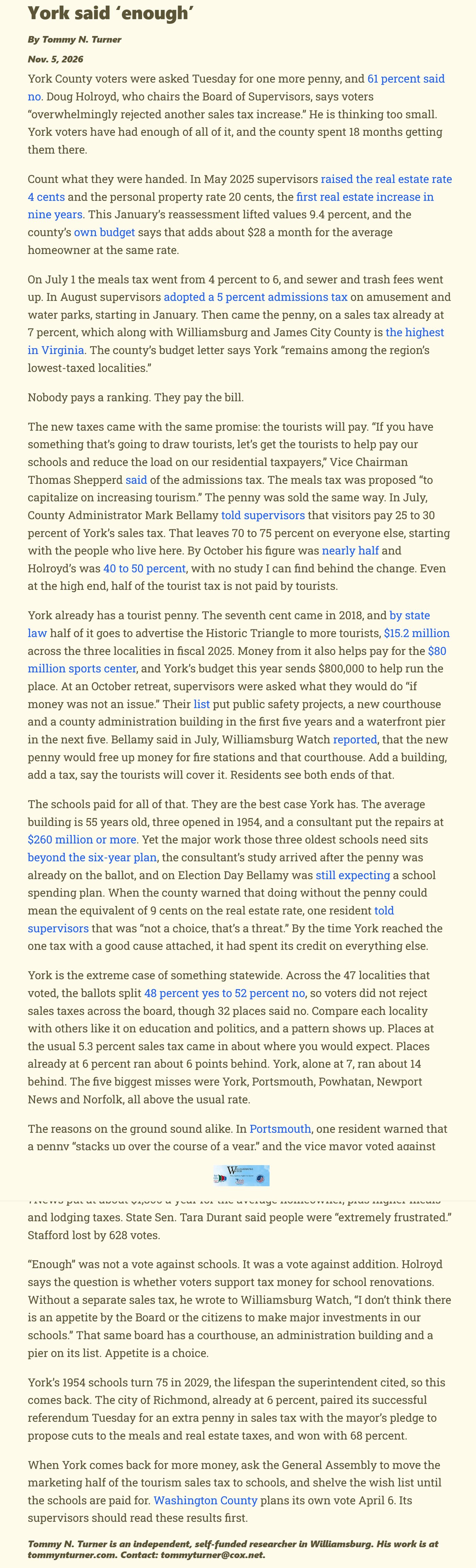 1 pageGuest opinion, the day after the Nov. 3, 2026 school sales tax referendums.
- Who goes dark first, data centers or us?
Botetourt County's website promises that homes, schools, hospitals and emergency services come before Google's data center when power runs short. The county can make that promise and has no power to keep it: Appalachian Power would do the cutting, and no Virginia rule tells it whether homes go dark before data centers. The commission should write the county's answer into a rule the utility has to follow, and DEQ should write the generator trade into Google's air permit, with every emergency run reported in public.
The Roanoke Times ·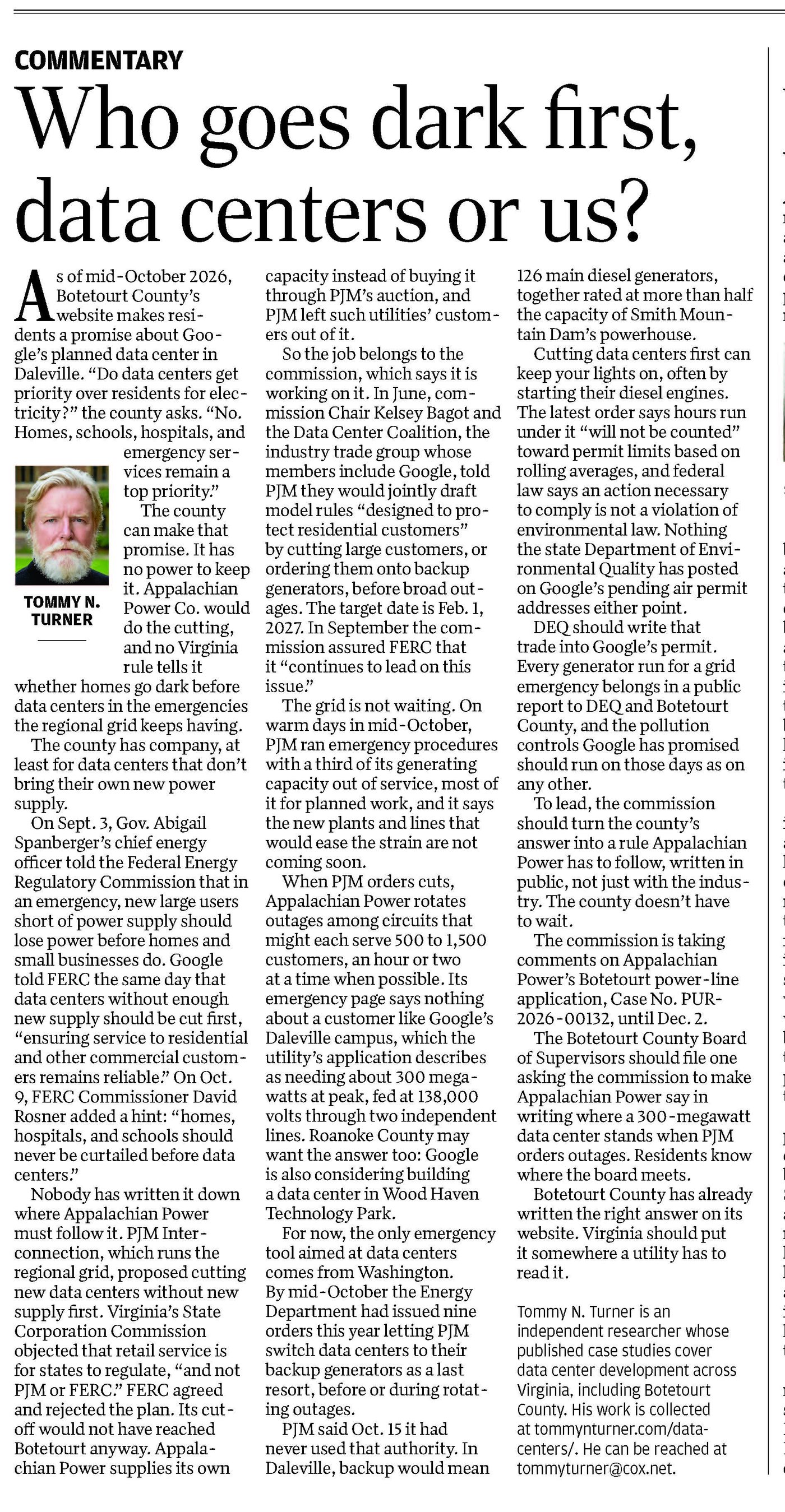 1 pagePrint, Sunday A15, November 1, 2026 (Commentary). Web headline: "Commentary: Virginia still hasn't decided who goes dark first." Draws on the Botetourt case study (20673512); bio links /data-centers.
- James City County wants it all. The budget says pick two.
James City County said no to 770 houses, lost 419 jobs at Avid Medical eight days later, and raised the real estate, meals and admissions taxes 3-2. Where the general fund's money comes from, what a rezoning can make growth pay, and why sending the Grove battery project away gets Grove nothing and the rest of the county two cents on the rate.
Williamsburg Watch ·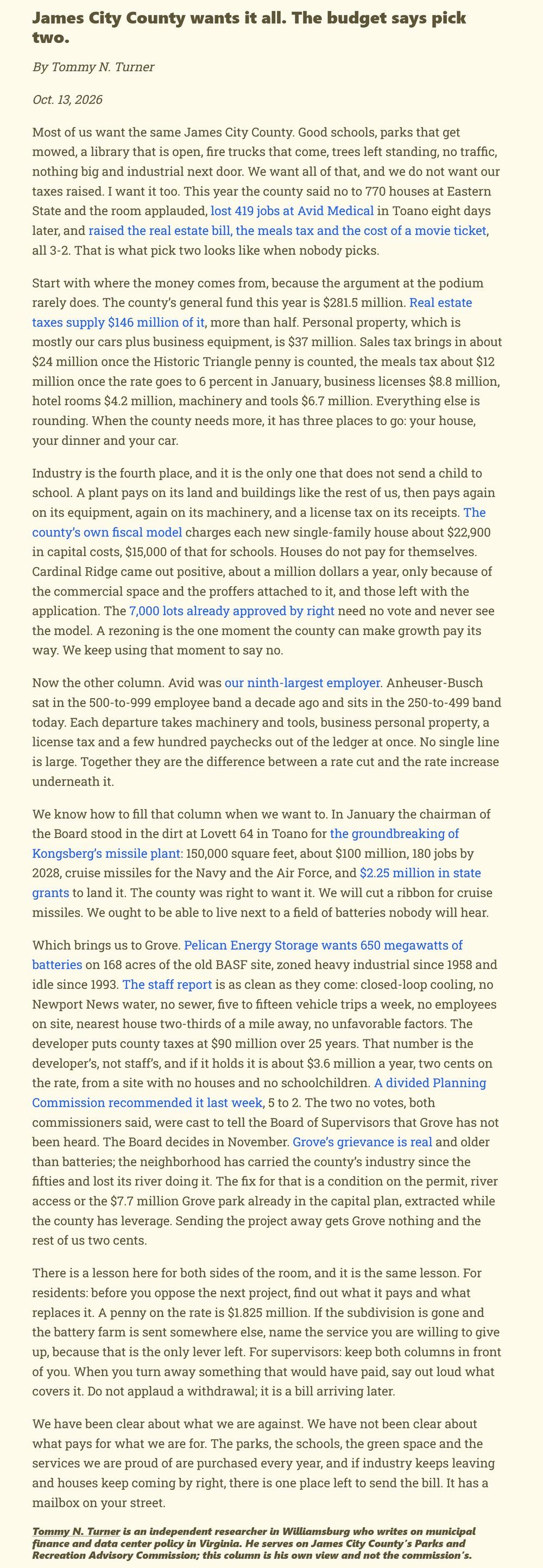 1 pageWilliamsburg Watch runs guest opinions on one rolling page, subscriber-only past the opening paragraph.
- Local governments cut out the public
Botetourt, Wythe, and Pulaski each disclosed on schedule. The problem is the schedule — information arrives after a project has accumulated enough commitments to make reversal expensive.
The Roanoke Times ·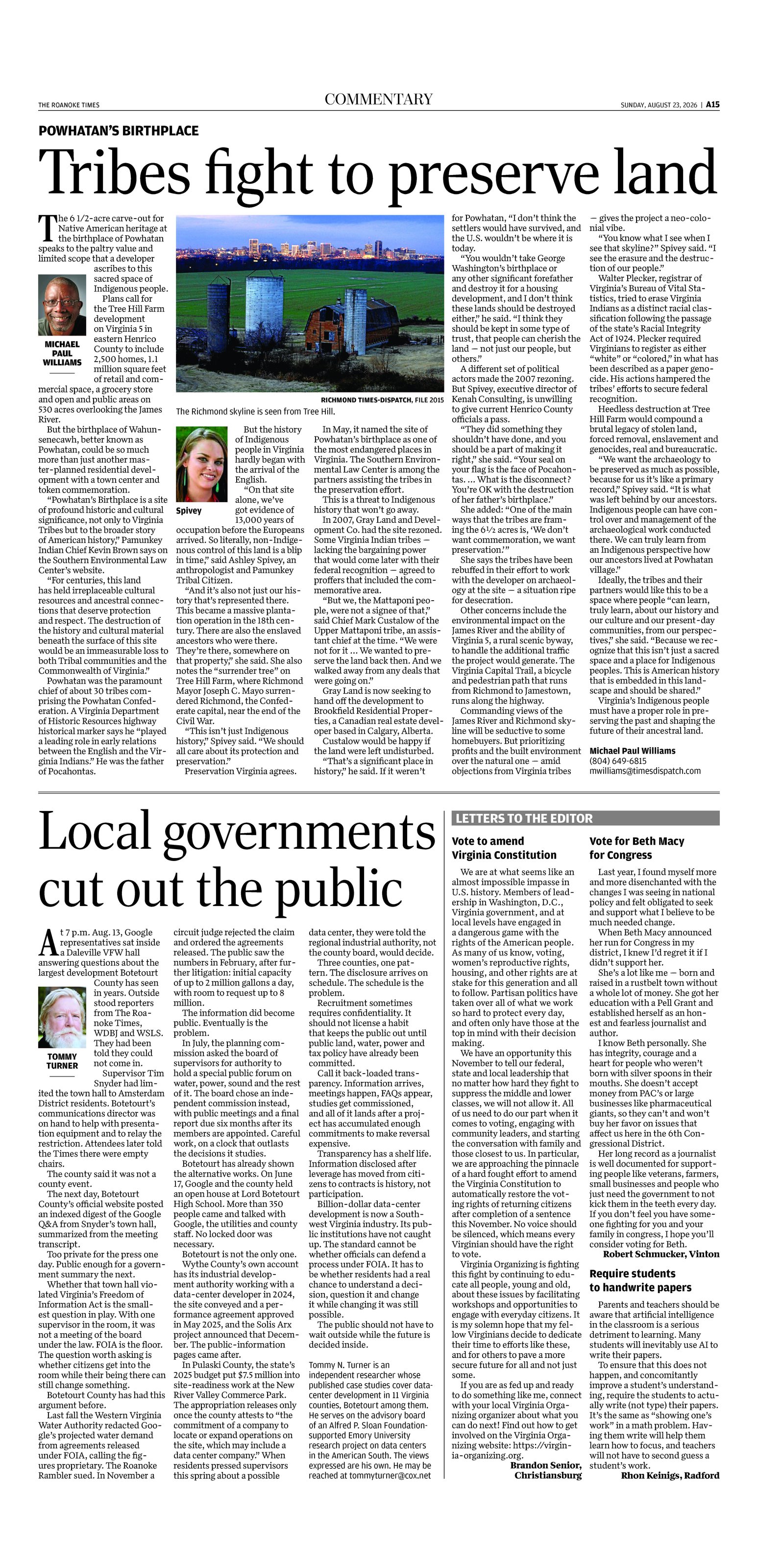
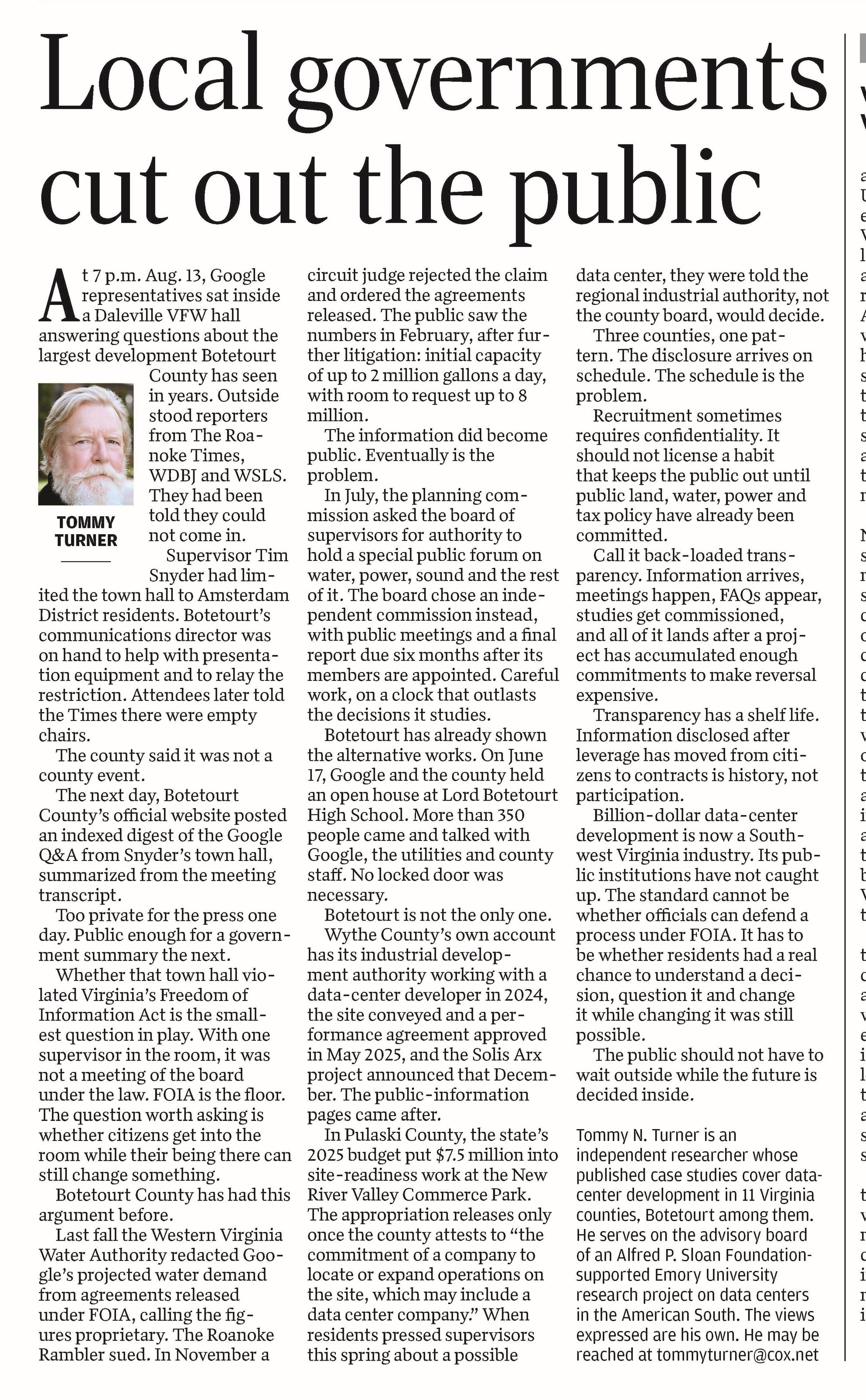 2 pagesPrint, Sunday A15, August 23, 2026. Web headline: "Commentary: The public interest shouldn't be an afterthought."
- Williamsburg Watch column on JCSA permit renewal implications
What the DEQ technical evaluation implies for the JCSA groundwater permit renewal — and for James City County's growth assumptions underneath it.
Links to Williamsburg Watch opinion index; individual permalink pending - Radford named its distress. It hasn't named the cure.
- Researcher: The bill came dueRadford diptych, part 2 of 2
- Researcher: What the foundry took from RadfordRadford diptych, part 1 of 2 — also deposited as Zenodo 20612127
- Early warning signs of Radford's fiscal distress
- As James City County budget adoption looms, disconnect between supervisors and residents is glaringly apparent
- Column: Who is counting taxes in James City County
- More thoughts about budgeting, taxes — a letter to the James City supervisors
- Letter to JCC Supervisors
- Commentary: Taxing past the breaking point
James City County residents count taxes cumulatively; the board counts them categorically. That mismatch is the piece.
The Virginia Gazette ·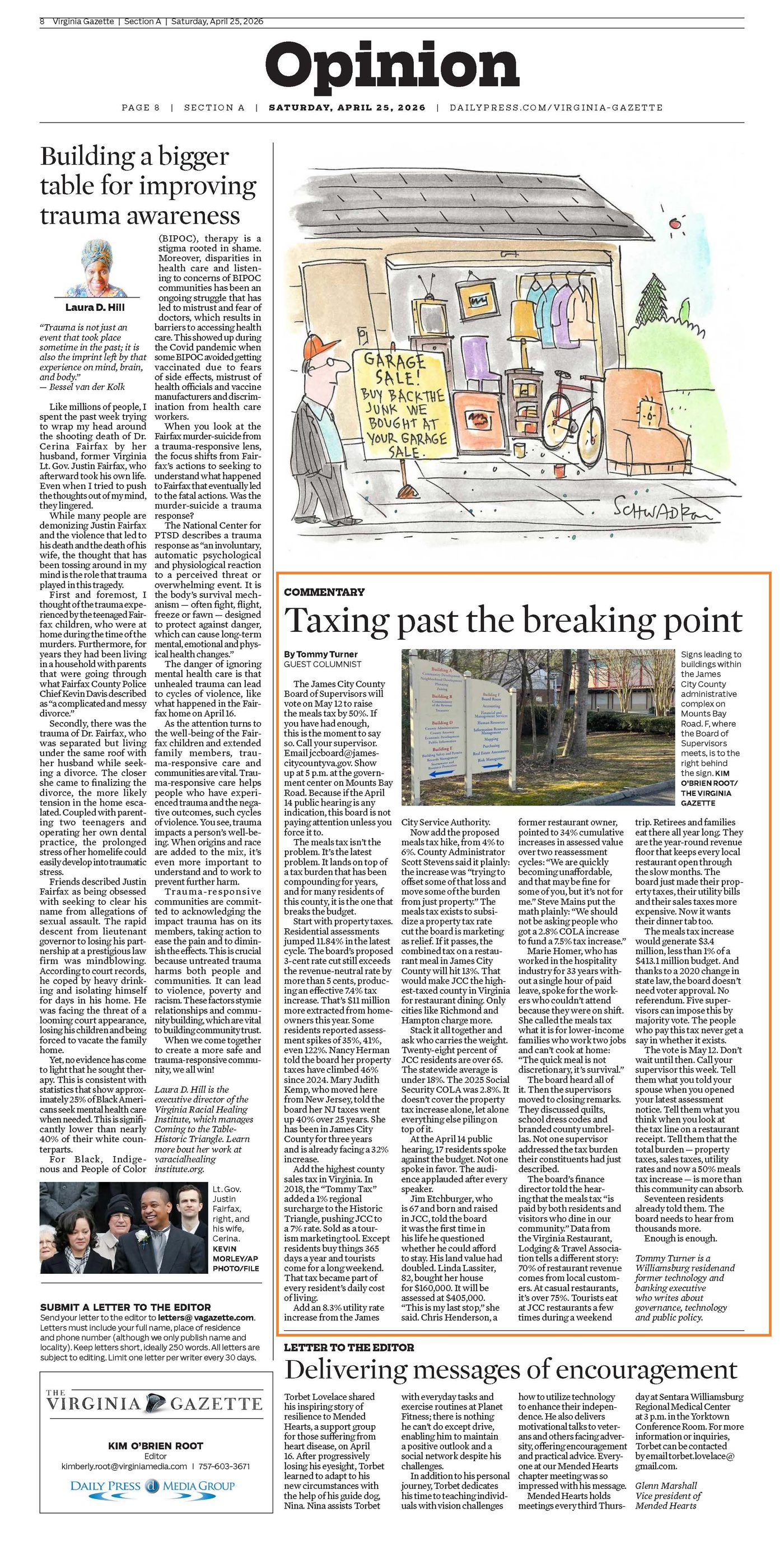 1 page
- A quiet digital fence around the Historic TriangleThe Virginia Gazette / Daily Press ·
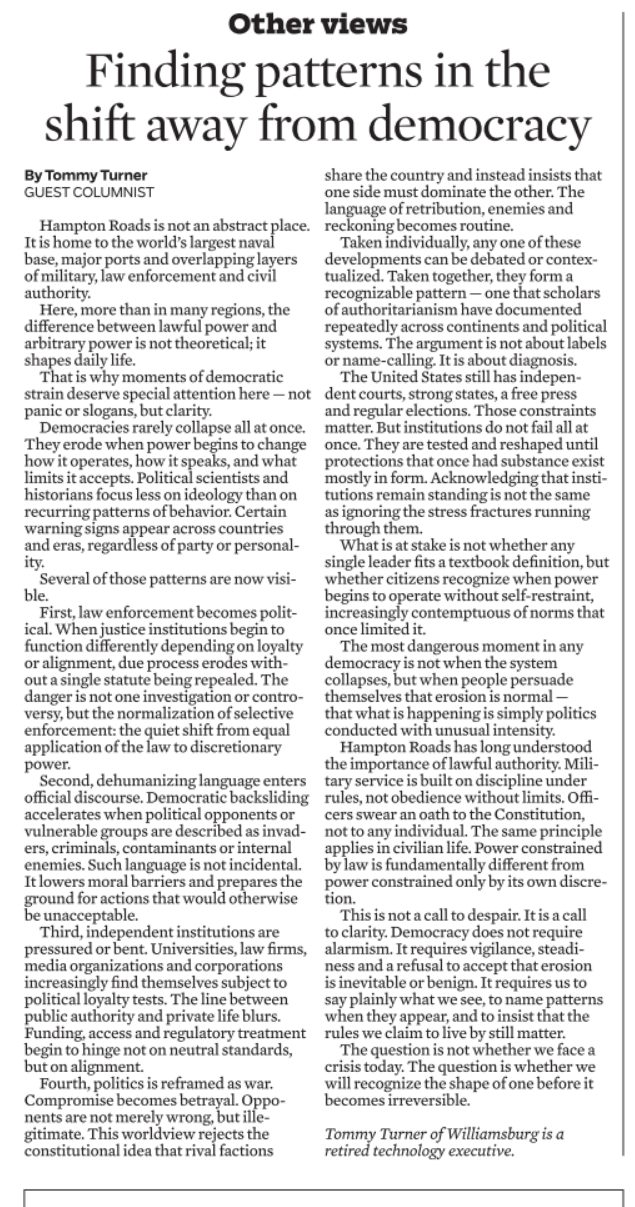
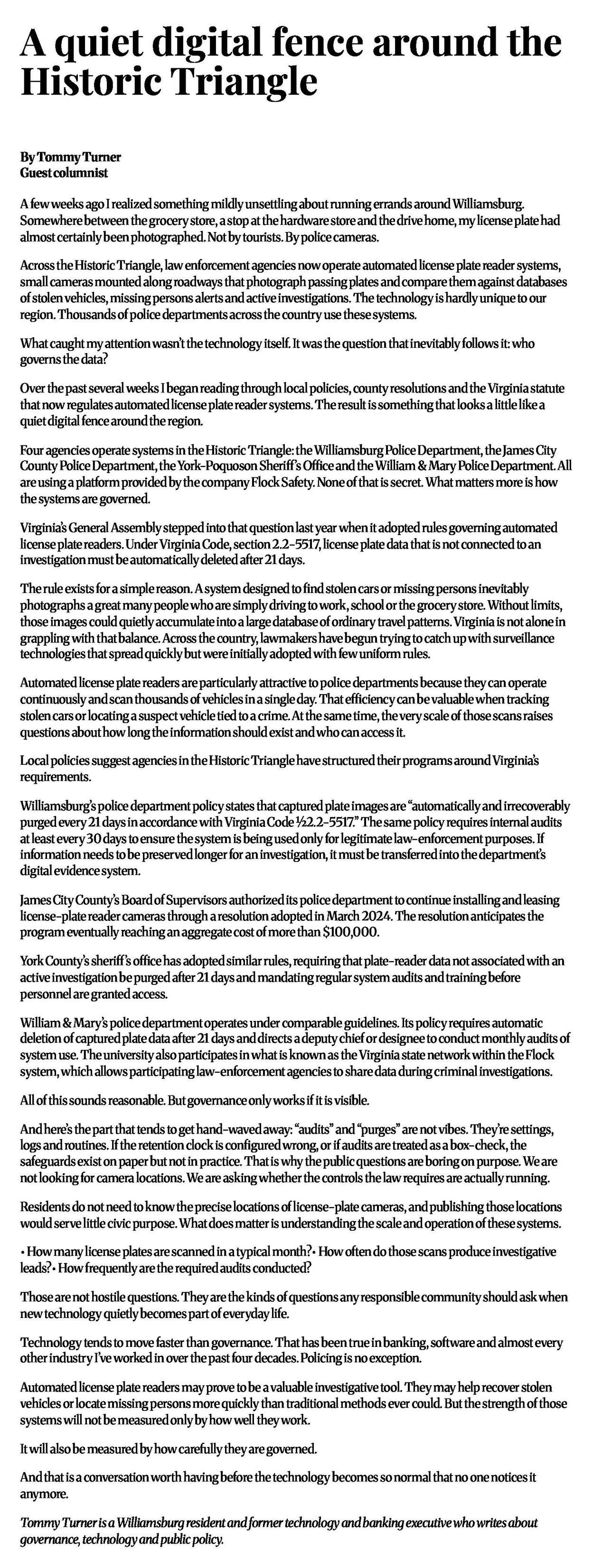 2 pages